Writing to Think: Two Decades of Figuring Things Out in Public
· 10 min readI’ve been writing about technology since 2004. That’s over twenty years of blog posts, platform migrations, and long stretches of silence. If you looked at my publishing history on a timeline, you’d see bursts of intense activity separated by years of nothing. The pattern tells a story I didn’t fully understand until recently.
I don’t write to share what I know. I write to figure out what I know.
The Real Reason I Write
There’s a thing that happens when you’re deep in a technical problem — you’ve got six browser tabs open, three terminal windows, and a half-formed understanding of why something isn’t working. You think you understand it. You can feel the shape of the solution. But you can’t articulate it yet.
Writing is how I close that gap. It is often how I find what I call the elegant solution to a problem rather than the brute force one.
When I sit down to document how I got Ceph running on a cluster of machines that were never designed for distributed storage, or why a Jekyll plugin breaks in a way that makes no sense until it suddenly does, I’m not writing for an audience. I’m writing for the version of me that’s still confused. If I can explain it clearly enough that someone else could follow along, then I actually understand it. If I can’t, I don’t — and the writing shows me exactly where the holes are.
That is sometimes why I have draft articles that never see the light of day — because I never solved the problem to my satisfaction. Sometimes I publish them in the hopes someone else (even a future me) will see a solution.
This is the Feynman Technique dressed up as a blog. Explain it simply or admit you don’t get it yet.
I had a model for this before I knew I had one. When I was an undergrad at NC State, a graduate student named Marshall Brain maintained an AFS locker called mb_info. You’d add it to your local AFS filesystem and find whatever Marshall was currently working through — text files explaining things he was learning, shared openly with anyone who stumbled across them. That was the seed of what became HowStuffWorks. Marshall wasn’t writing to teach. He was writing to think, and the teaching was the side effect. I didn’t connect those dots until much later, but the model stuck with me.
The Timeline Tells the Story
My publishing history has a pattern:
xychart-beta
  title "Blog Posts Published Per Year"
  x-axis [2001, 2004, 2005, 2007, 2008, 2010, 2011, 2012, 2013, 2014, 2015, 2016, 2017, 2018, 2019, 2020, 2021, 2022, 2023, 2024, 2025, 2026]
  y-axis "Posts" 0 --> 60
  bar [1, 3, 2, 2, 1, 4, 17, 9, 2, 9, 7, 2, 0, 0, 0, 0, 0, 0, 3, 24, 33, 59]
2026 is on pace to be the biggest year yet — fifty-nine posts published or scheduled with forty-seven more drafts in the pipeline. The bar chart doesn’t even know about those yet.
xychart-beta
  title "2026 Projection: Published + Drafts"
  x-axis [2023, 2024, 2025, "2026 published", "2026 projected"]
  y-axis "Posts" 0 --> 110
  bar [3, 24, 33, 59, 106]
The seven-year gap from 2017–2022 is hard to miss. So is the explosion after it.
- 2001–2008 — Nine posts. Life updates, career moves, figuring out what a blog even was.
- 2011–2012 — Twenty-six posts in two years. I’d gotten my hands on a Seagate BlackArmor NAS and couldn’t stop pulling it apart. Every post was me working through another layer of that hardware.
- 2013–2016 — Twenty posts across four years. Steady but not urgent. I was learning, but not struggling with anything hard enough to need the writing.
- 2017–2022 — Nothing on the blog. Zero posts for nearly seven years. But I wasn’t not writing — I was writing constantly. Research papers for Georgia Tech’s OMSCS program. Enterprise architecture documents at work. Security narratives explaining why something works and is safe to use, or compensating controls justifying why something doesn’t meet the letter of a policy but satisfies the underlying security goals. Piles of writing. I just wasn’t writing here.
- 2023 — Three posts. Testing the waters again.
- 2024 — Twenty-four posts. The homelab buildout year. Proxmox, Ceph, ZFS, networking — every week brought a new problem that needed to be written through.
- 2025 — Thirty-three posts. The writing habit fully locked in. Jekyll deep dives, Ceph storage, Proxmox lessons learned — a post nearly every week.
- 2026 — Fifty-nine posts already published or scheduled and we’re not even halfway through the year. Forty-seven more drafts in the pipeline. Something broke open.
The seven-year gap is the most interesting part. I didn’t stop writing during that time — I was producing more words per year than I ever had. Academic papers, architecture documents, security assessments, policy justifications. The writing was constant, but it was all locked behind corporate firewalls and academic walls. None of it was public, none of it was searchable, and none of it fed back into the kind of community conversation that a blog enables. Looking back, I think I lost something during that period. Not knowledge or even writing discipline, but reach. The kind of reach you only get when you force yourself to explain what you’re doing in a way that anyone can find and respond to.
When I came back to writing in 2023, it felt like turning on a light in a room I’d been navigating by feel.
Writing as Debugging
Programmers have a concept called rubber duck debugging — you explain your code to an inanimate object and the act of explaining reveals the bug. My blog is a very elaborate rubber duck.
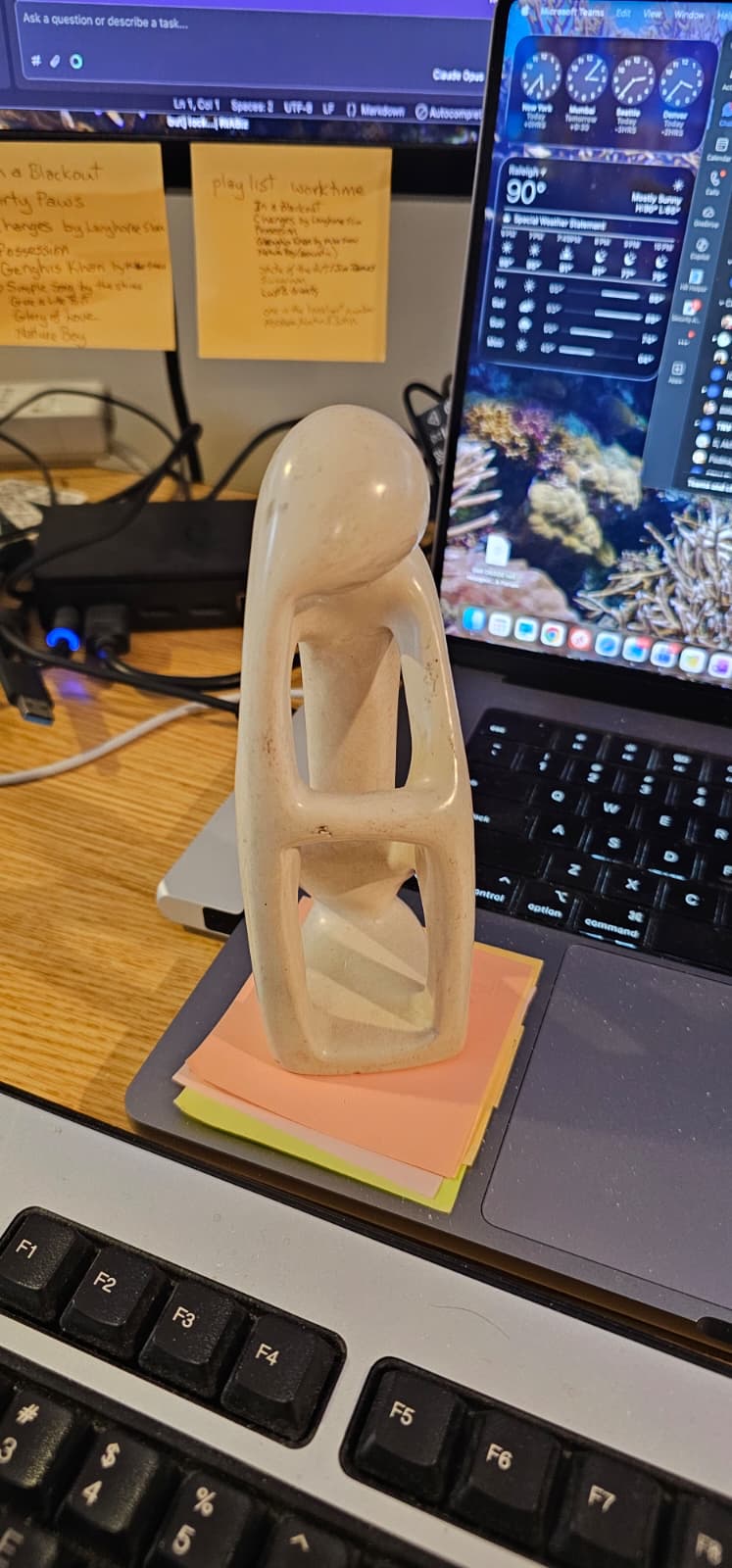
I have a small stone figure that sits on my desk. He’s been there through graduate school, through the seven-year writing gap, through every late-night debugging session where I couldn’t figure out why something wasn’t working. I talk to him. He listens. He never tells me I’m wrong, but somehow the act of explaining the problem out loud to him — or writing it down — always reveals where I went wrong. He is my rubber duck, my confidante, and my totem for thinking hard problems through.
I can’t count the number of times I’ve started writing a post about how I solved something, only to realize halfway through that my solution was wrong, incomplete, or accidentally correct for the wrong reasons. The writing caught what the doing missed.
A few examples from recent memory:
- Writing about Ceph nearfull warnings forced me to actually understand erasure coding math instead of just trusting the defaults.
- Documenting my Jekyll GDPR implementation revealed three edge cases I’d missed in the code.
- The ZFS boot mirror series started as a quick how-to and turned into a two-part deep dive because the first draft showed me I didn’t understand the failure modes.
Every one of those posts made the underlying work better. The writing wasn’t a record of what I’d done — it was part of doing it.
Sharing Is a Side Effect
Here’s the part that took me twenty years to be honest about: sharing is a byproduct, not the goal.
I publish these posts because making them public raises the stakes just enough. If it’s just notes in a private wiki, I’ll cut corners. I’ll write “do the thing with the config” and move on. But if someone might actually read it — even if nobody does — I’ll make sure the commands actually work, the explanations actually explain, and the logic actually holds.
The audience is a forcing function for quality because nobody wants to look foolish in public. But it’s not the motivation.
The motivation is that I genuinely cannot figure out complex things without writing them down. My brain needs the structure that sentences and paragraphs impose on messy, nonlinear problem-solving. Code is one kind of thinking. Writing is another. I need both.
What’s Missing: The Conversation
So if sharing isn’t the primary goal, why does it bother me that a static Jekyll blog on GitHub Pages is essentially a one-way street?
Because there’s a difference between sharing and interaction.
I set up Giscus comments backed by GitHub Discussions, and it works fine technically. But the barrier to commenting on a static blog is high — you need a GitHub account, you need to find the post, you need to care enough to leave a thought. The result is that most posts get zero comments. The writing helps me think, but I’m thinking alone.
What I actually want is the back-and-forth. Someone who reads a post about Ceph storage economics and says “have you considered this other approach?” or “I tried that and here’s what happened.” Not engagement metrics. Not likes. Actual technical conversation with people who are working on similar problems.
That’s the piece a static blog can’t provide, and it’s why I have set up Substack for the coming year.
Why Substack (and LinkedIn)
I’m not abandoning the blog. The Jekyll site is the permanent archive — version controlled, self-hosted, no platform risk. Every post I’ve written since 2001 lives there and will continue to live there. It is where I write about whatever interests me — technical deep dives, homelab experiments, infrastructure patterns, and the occasional tangent into things that have nothing to do with my career.
But a static blog is a one-way street. I needed two more channels, each solving a different problem:
Substack solves the interaction problem:
- Email delivery — Posts land in inboxes instead of waiting to be discovered. The people who want to read them don’t have to remember to check a website.
- Reply culture — Substack’s comment and reply model is lower friction than GitHub Discussions. People actually respond.
- Discovery — Substack has a built-in network of readers interested in technical content. My Jekyll blog has whatever Google decides to send my way.
- Depth — Longer-form strategic and leadership pieces live here as the persistent, shareable versions.
LinkedIn solves the reach problem:
- Network access — 500+ connections who are former colleagues, managers, and industry peers. A Substack article that nobody reads doesn’t move the needle. A LinkedIn post that hooks former colleagues into reading the full piece — and commenting from their own experience — is worth more than anonymous page views.
- Professional context — LinkedIn is where recruiters, hiring managers, and executive peers see your thinking. The blog proves you build things. LinkedIn proves you think about why.
- Amplification — Short posts (300–800 words) that distill the key insight from a Substack article into a hook, then link to the full piece.
The three channels reinforce each other: the blog is the technical source of truth, Substack is where the conversation happens, and LinkedIn is the amplifier that drives reach into my professional network. The writing process doesn’t change. The thinking-through-writing doesn’t change. What changes is that the writing reaches people who can respond to it.
178 Posts Later
I’ve published 178 posts across twenty-plus years. The topics range from NAS hacking to Ceph cluster economics to Jekyll plugin development to tankless water heater maintenance. The through-line isn’t the technology — it’s the process of encountering something I don’t fully understand and writing my way to understanding it.
The bursts in my publishing history correspond exactly to periods when I was building something new and struggling with it. The silences correspond to periods when I was either too busy to write or — more honestly — not struggling enough to need the writing.
I’m in a burst right now. Forty-seven drafts in the pipeline, posts scheduled through mid-2026, and a Kubernetes-on-Proxmox project generating new material every week. The homelab keeps breaking in interesting ways, and every break is a post waiting to happen.
If you’ve read this far, you’re probably someone who thinks by writing too. Or you’re considering starting. My advice is simple: don’t write for an audience. Write for the confused version of yourself. The audience, if it comes, is a bonus. The understanding is the point.
And if you want to actually talk about any of this — Substack is for the conversation, LinkedIn is for the professional context, and the blog is where it all starts.